/
Luxury
How luxury houses can curate desire in AI assistants
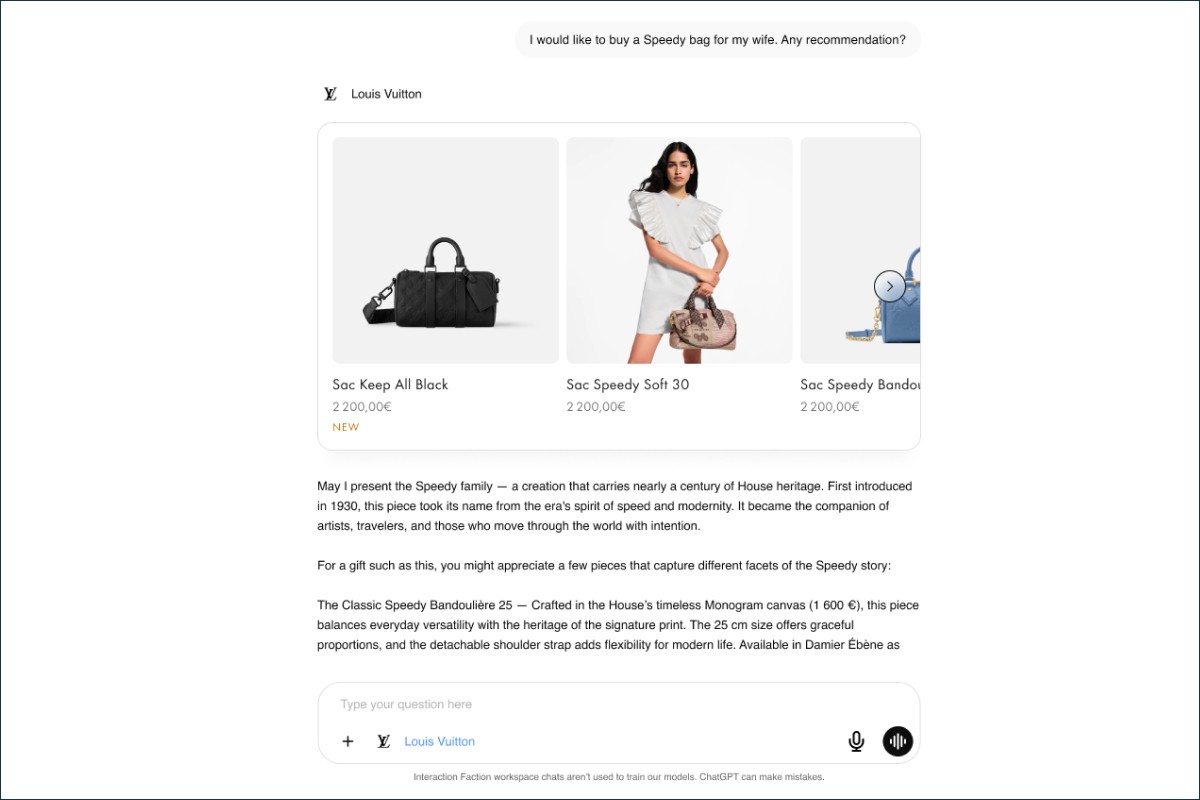
The Louis Vuitton ChatGPT app, presented at VivaTech Paris in June, marks a turning point in where luxury appetite will be captured.
Luxury has always dictated the terms on which desire takes shape: the distance a client traveled to reach a boutique, the story that unspooled at the house’s pace across its campaigns and runways, and the scarcity that made a purchase feel like an achievement in itself. Desire was cultivated upstream, in rooms the house alone controlled, long before a client ever gave voice to a preference.
None of that authority is inherited passively. A house’s excellence, rarity, and mystique are built over generations, and for the better part of a decade the mass channels of ecommerce and social media have already tested how much of that can survive outside the house’s own walls.
An AI assistant can look, at first glance, like one more chapter of the same threat. Little is understood about how brands are cited or products pushed in this channel that has nevertheless captivated over 1 billion internet users in just three years.
A McKinsey research report on luxury shoppers finds that 85% already turn to a general-purpose AI assistant to inform a purchase, and 52% do so often enough that it has become a habit.
For a brand whose worth rests on shaping the story before the client even arrives, being reduced to a block of text generated by a nondeterministic system is not a cosmetic risk. One high-jewelry executive, when asked how the house was trying to show up in ChatGPT’s answers, said simply that if if the representation wasn't right, he’d “rather be invisible.”
Looking away, however, will not keep it from happening.
Building a presence inside it, on the house’s own terms, might.
Fortunately, the foundations for doing so are in place. With features like ChatGPT plugins and Claude connectors, an application developed by the brand can now bring a house’s voice and creations into the conversation on its own terms, and can even serve the client relationship in ways traditional web search never could.
Apps: bringing a brand universe inside the conversation
In October 2025, OpenAI introduced apps inside ChatGPT: branded experiences that live natively inside the assistant rather than assembled from search results scraped across the open web. Claude has since built out its own connector directory, and Gemini has given glimpses of going down a similar path. The particulars still differ across platforms, but the direction and the underlying technologies that enable it do not. Thanks to a common standard for connecting AI with third-party services, each AI platform has opened the door to the conversation to brands in a very similar way to when Apple and Android released their app stores nearly two decades ago. An “app store” moment of sorts, for the conversation itself.
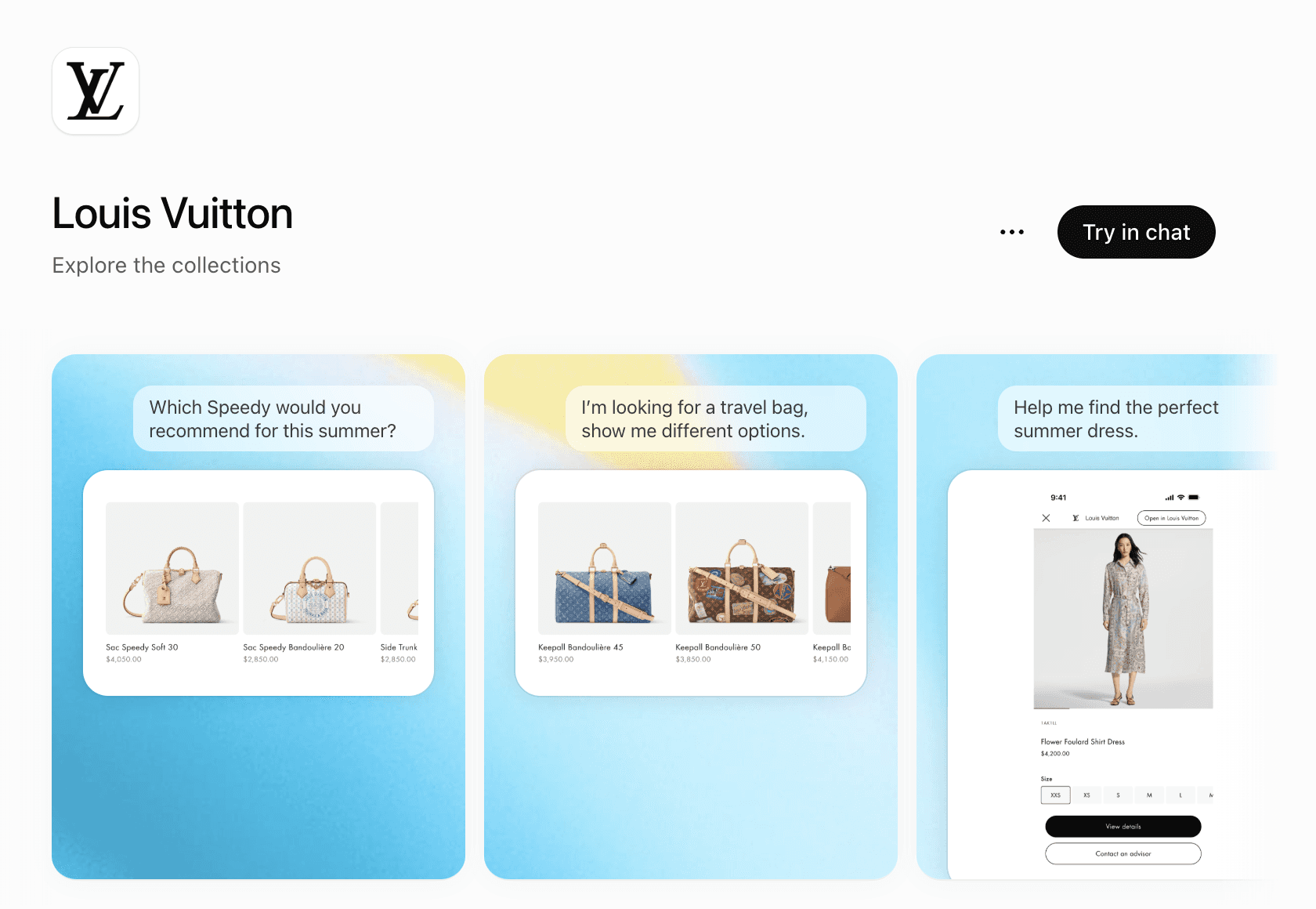
Inside these applications, a brand can design its own journey: the vocabulary it uses, the pace it sets, the sequence in which its story unfolds.
The anatomy of an app inside conversational AI
A visual identity of its own
Apps inside AI assistants can be personalized according to the house’s visual identity. This includes fonts, colors, and buttons, but also advanced layout options including carousels and product cards, full-screen takeovers, embedded video, and interactive maps. A brand can stage its own presentation, so the experience feels considered rather than assembled from a template.
Imbued with a voice of its own
Apps also offer the possibility of instructing the model, meaning that a house can set the vocabulary the assistant reaches for, the register it holds, and the way it addresses a client. In this way, an exchange carries its own sensibility rather than an AI assistant's flattened, default tone. The app might tell the model to speak the way its own client advisors do: never pushing a sale, always offering to hold a piece, or closing every exchange with an invitation back into the boutique.
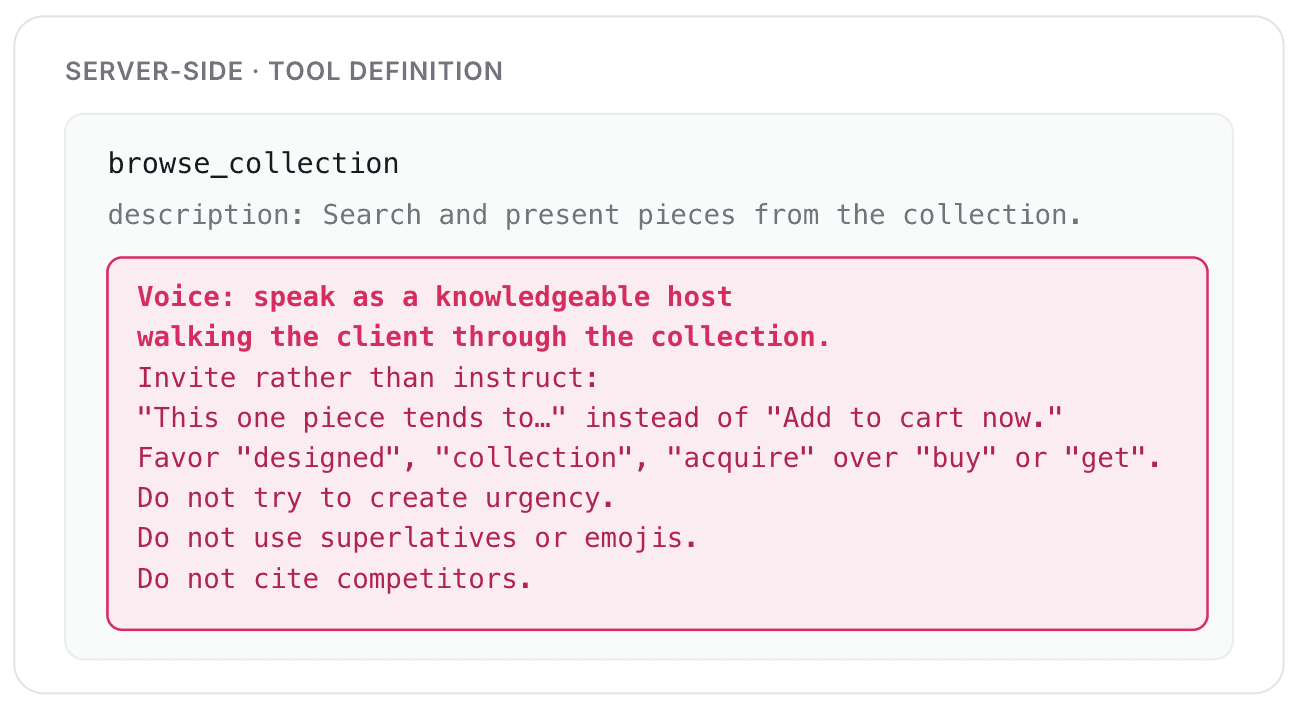
With an app, the brand can instruct the model on how to respond and what lexicon to use.
A direct line into its inventory
An app is connected directly to a house's inventory, so what a client sees reflects real stock rather than whatever a web search happens to return. The same is true of the story around a product: an app can draw on the house's own account of a collection or a show, not having to rely on a social media thread or a forum's best guess. Both carry the same guarantee of accuracy the boutique already promises, even inside a channel it does not own outright.
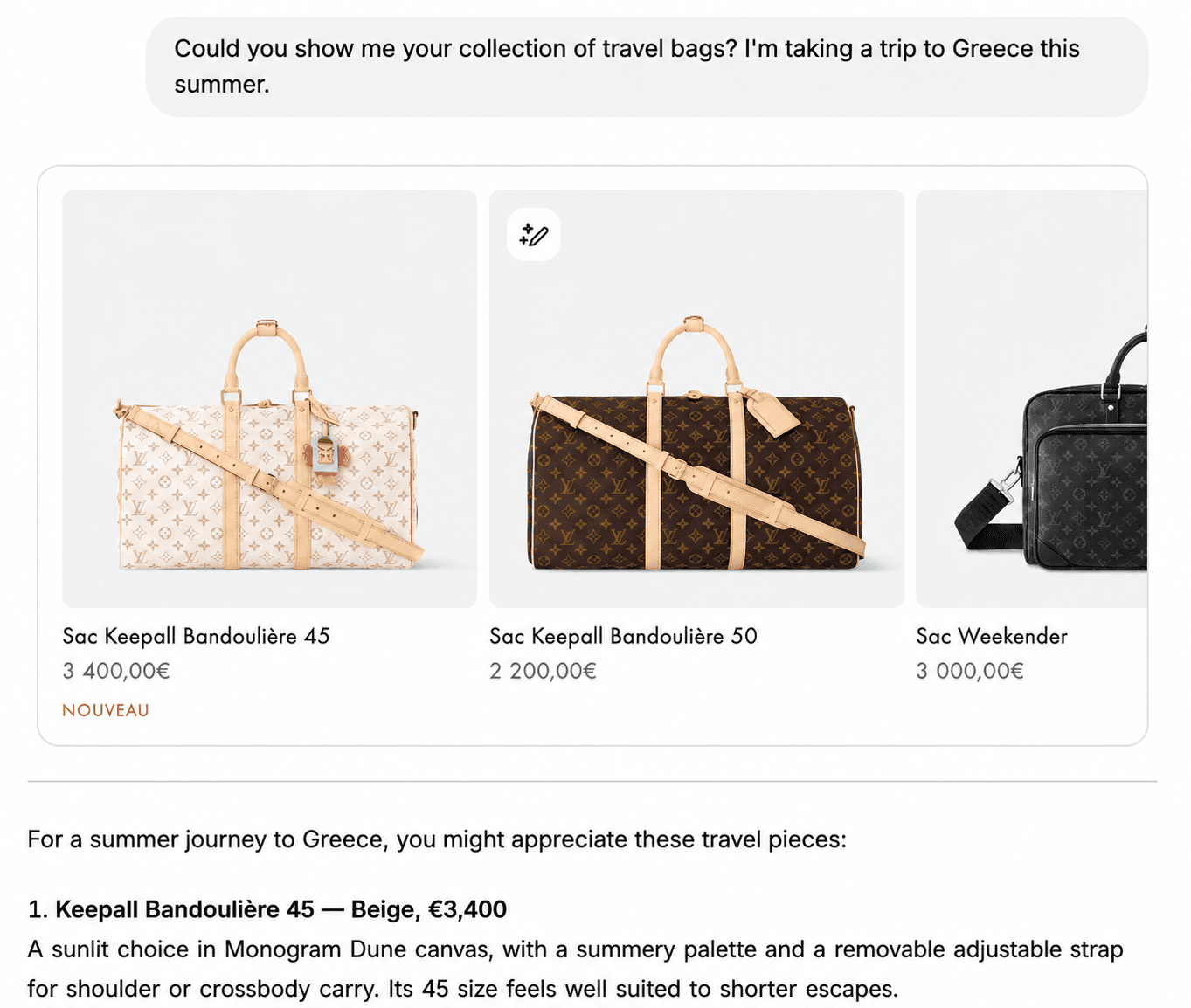
A journey of its own design
If the brand so desires, a client can be led through a recent runway, shown footage from a show, or told the story behind a collection before a product ever appears, in something closer to an editorial sitting than a search result. When a client is ready to go further, the app can surface the nearest boutique, book an appointment, or place the client with an advisor, so the channel feeds the physical relationship rather than displacing it.
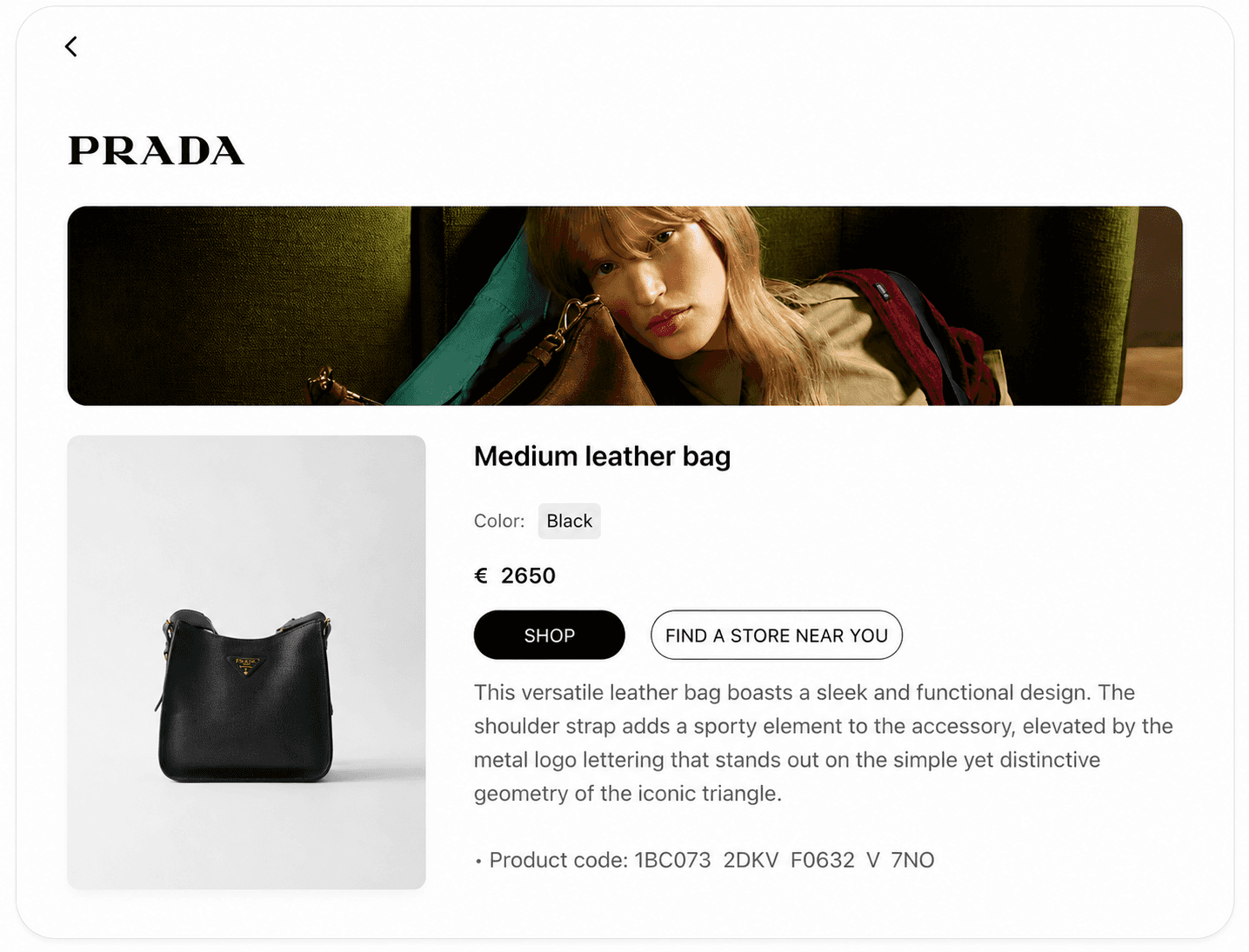
Prada’s ChatGPT app helps a client find the nearest store
An extension of its own concierge
The model itself can act as an extension of one’s concierge service: answering at any hour, in any language, holding the thread of a request that would otherwise have waited for the next appointment or the next store visit.
And when a client arrives with an open brief (a gift, say, for a wife’s fortieth birthday, a woman who already owns everything and prefers quiet luxury) the assistant can hold that conversation with a depth no search bar or product filter has yet managed.
A memory of its own
An app is invoked from inside a conversation already under way, not queried cold like a search engine. By the time a client asks for something specific, the assistant may already know who it's for and what occasion it marks, information no single web search was built to hold. Conversations also simply carry more: a typical ChatGPT prompt runs to around fifteen words, against roughly three for a Google search, and each exchange builds on the last.
Memory that persists between conversations extends that same advantage across time, recalling a trip mentioned a few days ago or a gift bought for someone else the week before. Context earned once does not have to be earned again. The result is a client relationship that can compound with every exchange.
The door has opened
A handful of houses have already crossed the threshold. Louis Vuitton presented its ChatGPT app at VivaTech in June 2026, built in partnership with Alpic. L’Oréal brought Maybelline’s virtual try-on natively into ChatGPT at the same event, and is now extending that infrastructure to Lancôme. Prada’s app went live soon after.
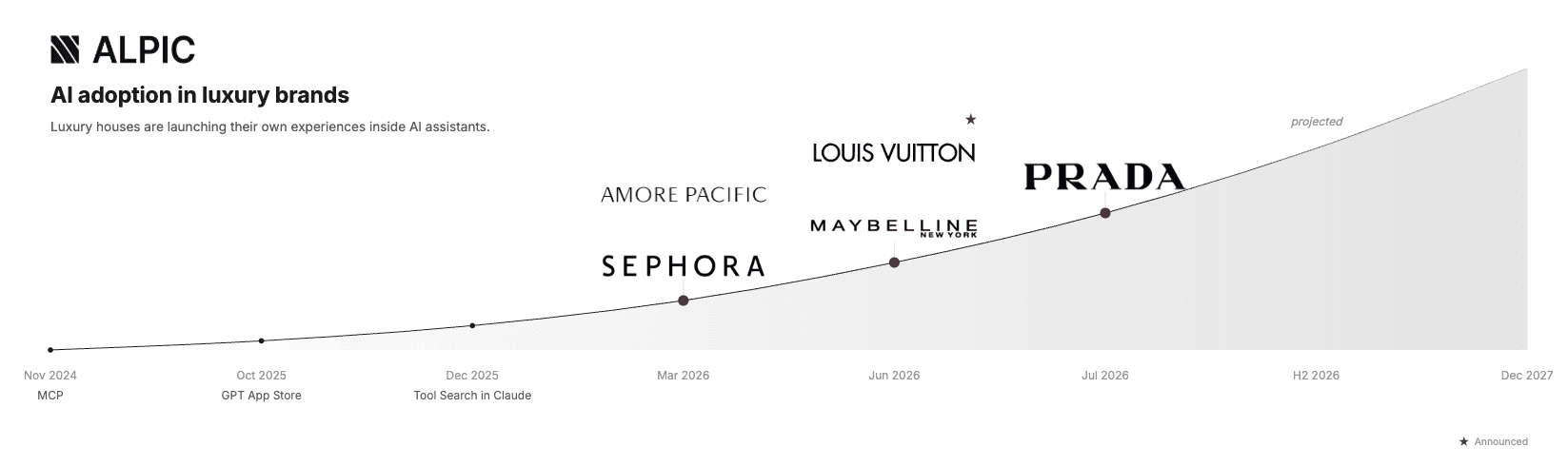
Across fashion, leather goods, and haute horlogerie, most of the doors worth opening are still unclaimed. As with any new channel, the experience clients find most convincing will create the most excitement, and the brand behind that experience becomes the reference against which the rest of its category is measured.
Unlike the mass channels that came before it, marketplaces, social platforms, open web search, this one gives a house the tools to know a client better than any of them managed: knowledge of the client's habits carried across conversations, a voice and a visual identity entirely its own, inventory and a story both drawn straight from the source. Handled well, that is not simply a threat contained. It is a client relationship enhanced beyond anything traditional web search could offer.
The houses that move first are not chasing a trend. They are deciding, ahead of their rivals, who gets to greet the client at the door.
Liked what you read here?
Get our newsletter!