/
Basics
GEO is now essential for brands… and it’s not enough.
In the past few years, a new marketing discipline has emerged: GEO, or Generative Engine Optimization. This practice involves structuring your online presence to appear in ChatGPT answers, Perplexity summaries, and Google AI Overviews. The sector already generates around $1 billion and is projected to reach $17 billion by 2034 (Dimension Market Research).
For the millions of consumer and B2B businesses that rely on the internet for distribution, the urgency is real. Brands have always needed to show up where attention is, and that attention is shifting fast. Instead of typing a query into Google, hundreds of millions of people now ask an AI.
GEO matters because it shapes how those AI systems reason about your brand when a user asks a question.
But it covers only part of the picture.
What gets less attention is what happens after the answer: when an AI agent stops responding to a question and starts acting on intent: booking the trip, completing the purchase, updating the record. This is a separate contest with its own infrastructure and its own distribution surface, and it's one every business that sells online will have to reckon with.
What GEO can and can't do
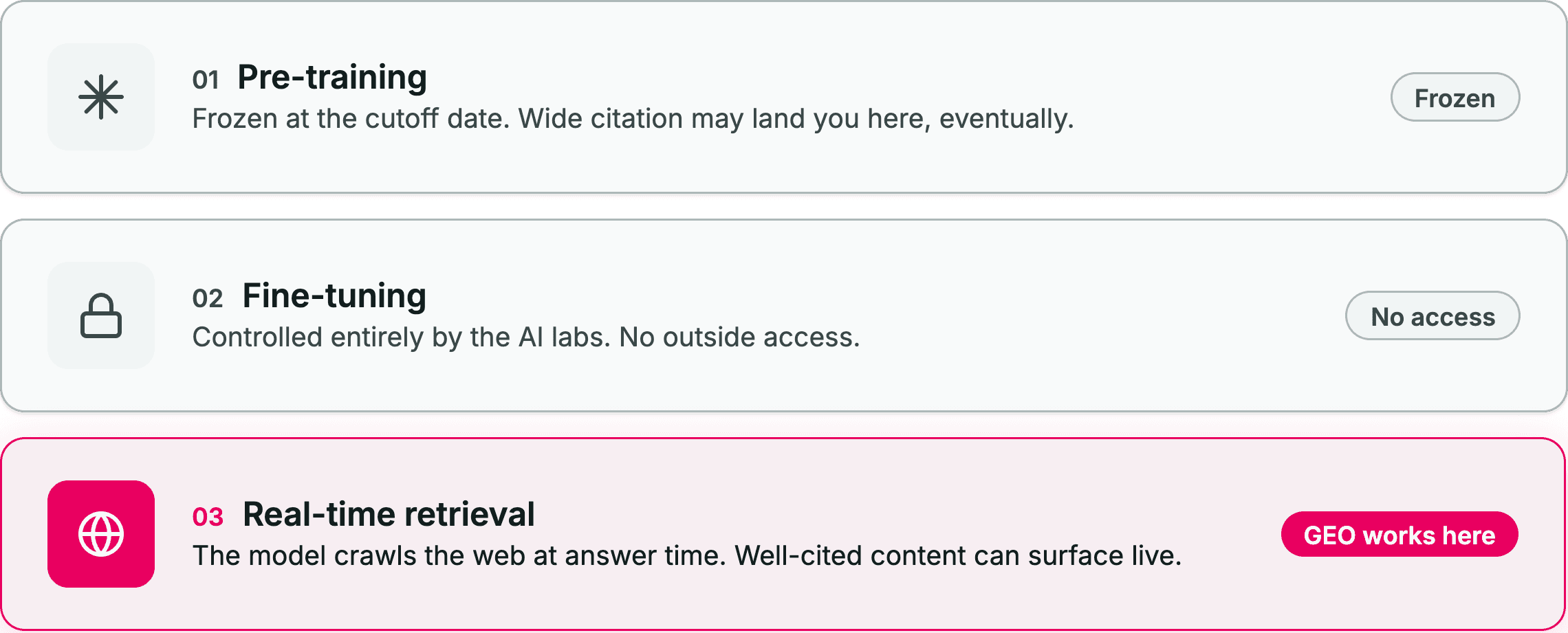
There are three ways an AI system accesses information, and only one of them is open to influence from the outside.
The first is pre-training, the knowledge baked into a model and frozen at its cutoff date. You can hope to appear here if your content is cited widely enough across the web, but the timeline runs months to years and placement is never guaranteed. The second is fine-tuning, a layer the AI labs control entirely; brands get no access to it. The third is real-time retrieval, and this is where GEO operates: when a model crawls the web at inference time, well-structured and well-cited content can surface in a live answer. GEO reliably influences this layer, and that is a genuine capability.
But it also has a ceiling.
GEO optimizes your position inside the answer, but it has no hold on what happens once the answer lands. A strategy built entirely around visibility is incomplete by design.
The real shift: from information to action
Search has always run on an information paradigm: a user asks a question, gets an answer, and then goes and uses your service. GEO reproduces that model faithfully, optimizing your presence so AI systems can find and cite you, in the hopes that a user continues on.
AI agents are collapsing that journey into an action paradigm. The user states a goal, and rather than explaining how to accomplish it, an AI can simply do it, often bypassing the clicks, the site visits, the page navigation, and a significant amount of the conversion funnel itself.
We already live partway inside that world. Roughly 60% of searches in 2025 ended with zero clicks (Semrush). In other words, the user reads an AI-generated answer without ever touching a brand's site. That figure climbed toward 68% in early 2026 as AI Overviews spread (SparkToro). The money is predicted to follow the same curve. McKinsey projects $3 to $5 trillion in global B2C retail revenue will flow through agentic commerce by 2030. Those numbers don't attach to citations; they attach to actions.
GEO has little to offer in this model. It was built for the information paradigm, not the one where execution is the service itself.
Action lives inside your systems, exposed through an AI-native interface
An agent can only interact with a business if it can reach the systems that run said business. Placing an order means touching live inventory; rescheduling a delivery means reaching into the logistics platform; completing a payment means calling the checkout workflow. All of this lives in a company's backend and APIs, and taking action means operating those the way a customer would.
Connecting an AI to that machinery used to be bespoke work. Now it runs on a standard. The Model Context Protocol, which Anthropic released in late 2024, became within a year the default interface for exposing AI to third-party tools and data, and has been adopted across ChatGPT, Claude, Gemini, and all major AI platforms.
What matters more is where those connections are distributed. OpenAI runs a plugin store inside ChatGPT; Anthropic runs a connector directory inside Claude. These are essentially “app marketplaces” where a user finds your service, installs it into their assistant, and lets the assistant call it directly. The web hasn't opened a distribution surface like this since the mobile app store nearly two decades ago, which quickly went from a curiosity to something no consumer business could operate without.
The twist this time is that the storefront lives inside a conversation, and what gets installed isn't an icon a user taps but a capability the agent invokes.
GEO and apps solve different problems
That capability is exactly what GEO cannot provide.
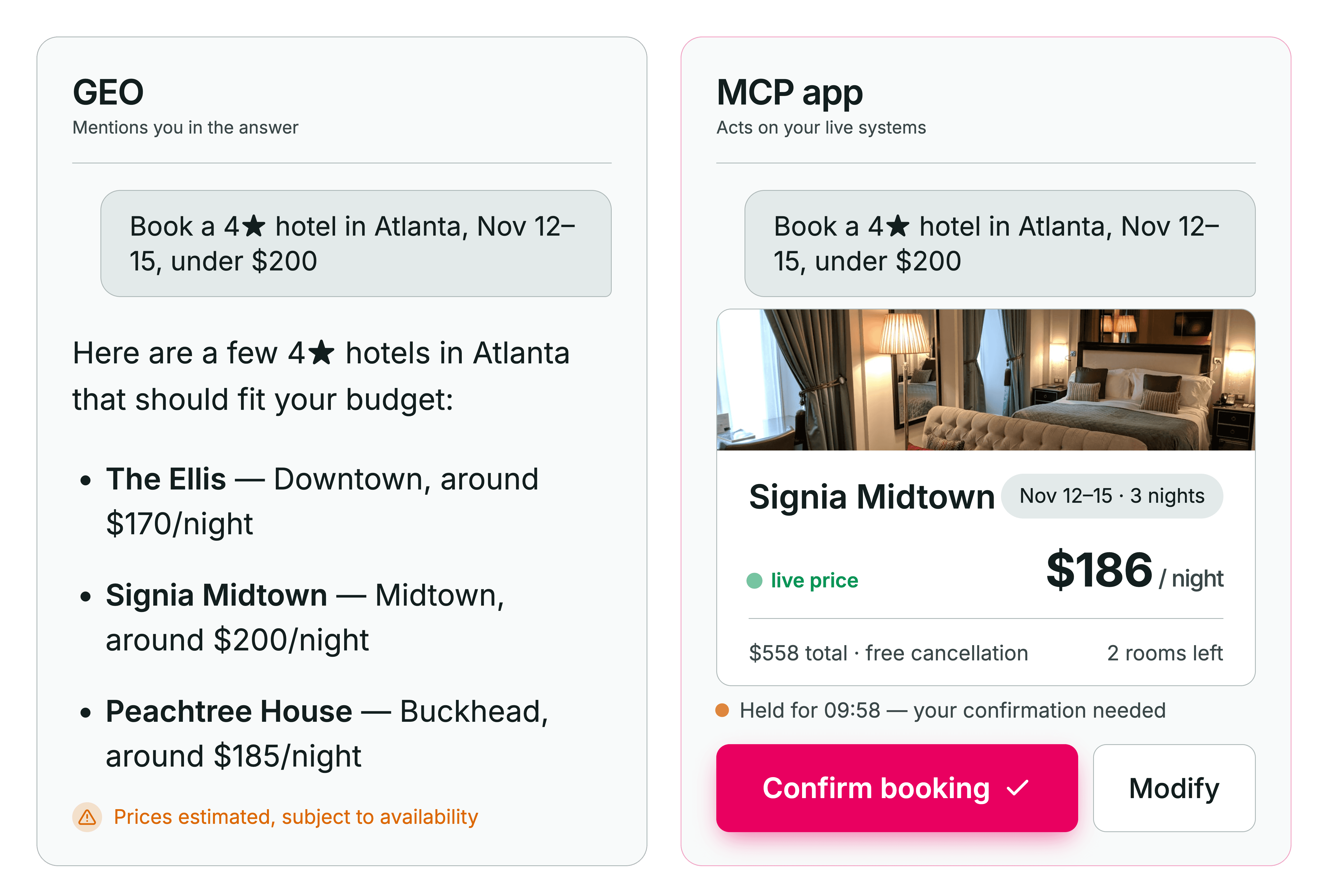
Picture one traveler in two worlds. Under GEO, they ask which business hotel in Atlanta is worth booking, and the assistant name-checks your property alongside a handful of rivals. If the write-up lands, the model might speak highly of your establishment. Then the traveler might open your site, might compare rates, might eventually book. You may have surfaced positively in the answer, but everything after that was beyond your reach.
With an app integration, the same traveler says, "book me a four-star room in New York, three nights from Wednesday, under $200." The agent reads your live availability, applies the constraints, offers two rooms, and closes the booking inside the conversation.

This split can be clearly seen the table below. GEO works through crawlers and training data and the payoff stays indirect, a citation that may or may not become a click and a sale. An app plugs an agent into your live systems, draws on data you control in real time, completes the transaction, and reports back which workflows ran and where the revenue came from.
GEO | MCP app | |
|---|---|---|
Optimizes for | Visibility in AI answers | Usability by AI agents |
Access method | Web crawlers, training data | Direct interaction with APIs and tools via the MCP protocol |
Action capability | None, informational only | Full: query, book, transact |
Data freshness | Unreliable (may be frozen at training cutoff, date from last web crawl or retrieved in real time) | Real-time, live data via tools you control |
Measurement | Estimated citation share | Direct usage analytics |
Revenue path | Indirect (brand → click → site → conversion) | Direct (agent → transaction) |
Table comparing GEO and MCP app
But it isn’t an either/or situation. Running both produces a read on AI-driven demand that neither delivers alone. GEO influences where you're cited and for which queries; your MCP app is how you are used. And the two feed into each other: where you're cited often but rarely invoked, there's demand your app isn't serving yet; where agents reach you but drop off, there's a flow to fix.
The 2026 AI-visibility playbook
An AI-native interface is becoming a standard channel, the way a website and then a mobile presence did before it. Major consumer brands already run one inside ChatGPT and other assistants, and for most companies the question isn't whether to build but whether the build survives production.
The work itself runs in five steps, from auditing where you stand today to measuring what agents do with your app once it’s live:
Audit your GEO exposure: Where are you cited, and where are you invisible?
Map your highest-value agent interactions: What would you want an AI to do on behalf of your customers?
Build and deploy your MCP app: Expose those interactions through an AI-native interface.
Register for discoverability: List in the MCP directories, your new SEO surface.
Measure and iterate: Work from direct usage analytics, not citation estimates.
Standing up production infrastructure for agents (hosting, auth, monitoring, store submission) is where most teams stall, and it's the layer Alpic is built to handle.
The bottom line: combine GEO and MCP app
GEO is a legitimate transitional play, and brands that ignore it entirely will feel the absence. But it carries a structural ceiling that no amount of content or online presence optimization can fix. As AI takes over more of discovery, comparison, and transaction, the interface that matters is no longer your website; it's an AI-native interface.
The companies that win the AI era won't just be the ones mentioned most in ChatGPT or Gemini answers. They'll be the ones invoked most by AI agents.
The question will no longer be "does AI mention me?" but "can AI act for me?".
Liked what you read here?
Get our newsletter!