AirHelp brings flight compensation into ChatGPT and Claude

B2C
Travel
ChatGPT & Claude App
AirHelp built a flight compensation checker that lives inside ChatGPT and Claude, so travelers can find out in seconds whether they are entitled to compensation for a delayed or cancelled flight. Working with Alpic, AirHelp shipped one app that runs across both platforms, folding multi-jurisdiction compensation rules into a single conversational flow. It's live today on ChatGPT and Claude.
AirHelp helps air passengers claim the compensation they're owed under EU, UK, Turkish, Saudi Arabia and Brazilian flight delay and cancellation law. Founded in 2013 and headquartered in Berlin, the company has checked more than 26 million claims and helped over 3,3 million passengers get paid on a no-win, no-fee basis. Its core product has always been the same question, answered as simply as possible: was your flight disrupted, and if so, what are you owed?
That question carries the company's mission with it. Passenger rights exist on paper, but they only count when people exercise them, and by AirHelp's own analysis roughly 60% of eligible travelers never pursue the compensation they're owed, usually because they don't know they qualify or expect the process to be a fight.
The challenge
Travelers increasingly turn to AI assistants for help with travel issues, and a delayed or cancelled flight is exactly the kind of situation people now bring to ChatGPT or Claude before they open an app or search the web. On its own, an AI model can commiserate or pull up information about compensation rules. AirHelp built an app that could take it a step further, answering the question inside the conversation and offering an actionable path forward, at the moment the traveler is frustrated at a gate or first sees a delay notification.
The hard part wasn't the interface, it was the logic underneath it. Compensation eligibility depends on a myriad of interacting factors, among them which regulation applies (EC 261, UK 261, Turkish SHY, etc.), how much notice the airline gave before a cancellation, whether a delay involved a missed connection, the influence of extraordinary circumstances, and those are just the ones that come up most often. That's a lot of conditional logic to fold into a natural-language exchange without burying the traveler in a long claims form. It also has to hold up across a global user base using flight data that's often messy: abbreviated airline codes, ambiguous multi-leg itineraries, and flights the model can't immediately match. On top of that, AirHelp needed one experience that worked on both ChatGPT and Claude, without standing up two separate engineering efforts to get there.
"Compensation rules are genuinely complicated: different legal regimes, notice periods, extraordinary circumstances. What we didn't want was to make that complexity the traveler's problem. The app asks a couple of questions and gives a straight answer: may be entitled or not, and how much."
Monika Laskowska-Kac, VP of Product Growth, AirHelp
The solution
AirHelp and Alpic built an app that turns "Am I eligible for compensation?" into a short, guided exchange rather than a wall of disclaimers. A traveler describes what happened, in their own words and in one of eight supported languages (English, French, Spanish, Italian, German, Polish, Portuguese, and Dutch). Example prompts AirHelp surfaces in-app:
"My flight from Barcelona to Milano was cancelled. Can I get compensation?"
"I flew from London (LHR) to New York (JFK) yesterday. It was 4 hours late."
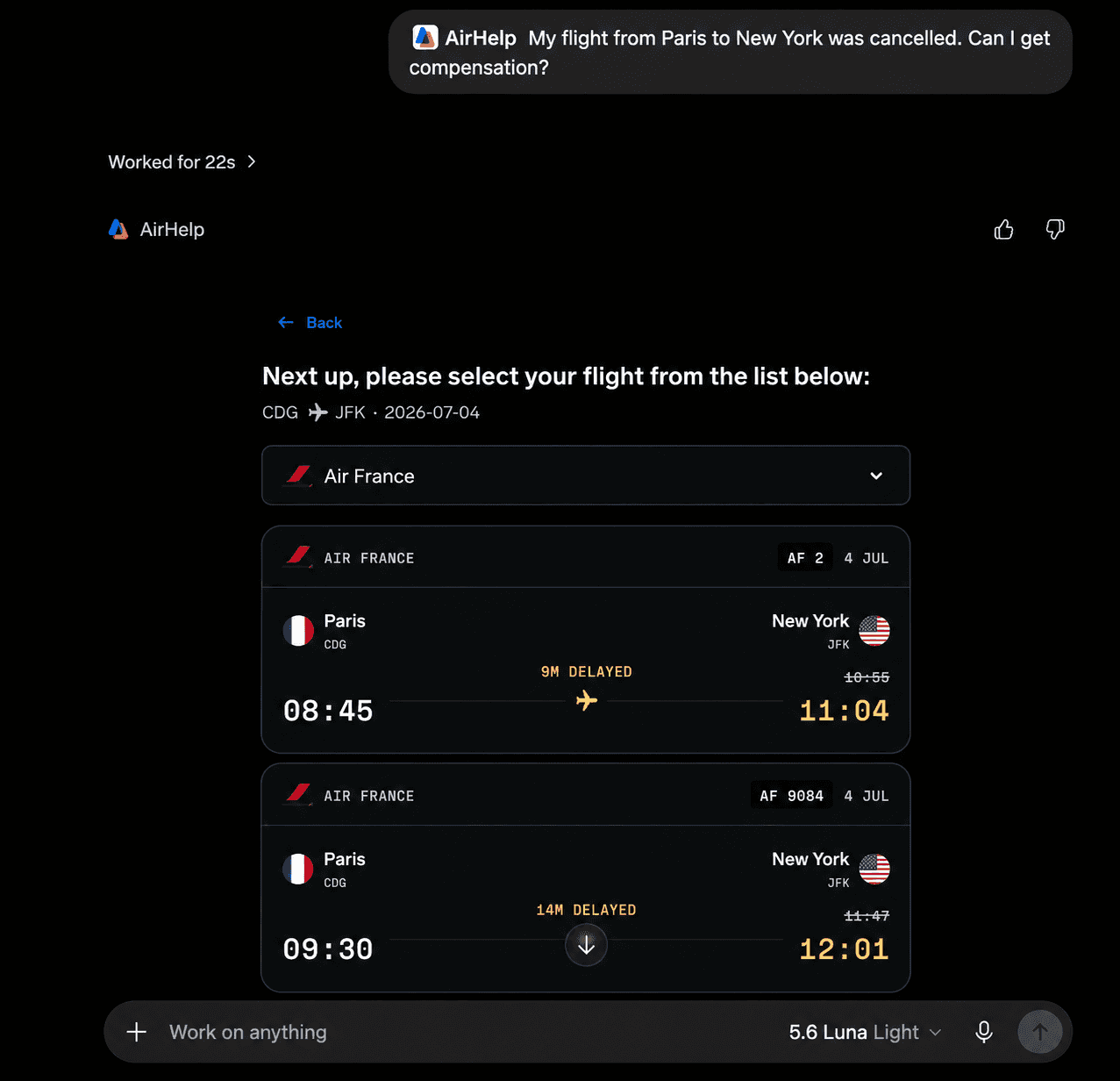
From there, the app asks only what it needs to resolve ambiguity, things like which airline or which leg of a connection was affected, or when the airline actually gave notice of a cancellation, since that detail alone can change the outcome under regulations like Europe’s EC 261. It narrows a route and a date down to the exact flight from AirHelp's own flight data, and returns a clear verdict: eligible, with an estimated payout amount and the regulation it falls under, or not eligible, with a plain-language reason. When a flight can't be matched automatically, the app falls back to a short enquiry form rather than leaving the traveler stuck. From an eligible result, a traveler continues on to AirHelp's website or mobile app to finalize the claim, with a universal link or QR code making that handoff quick.
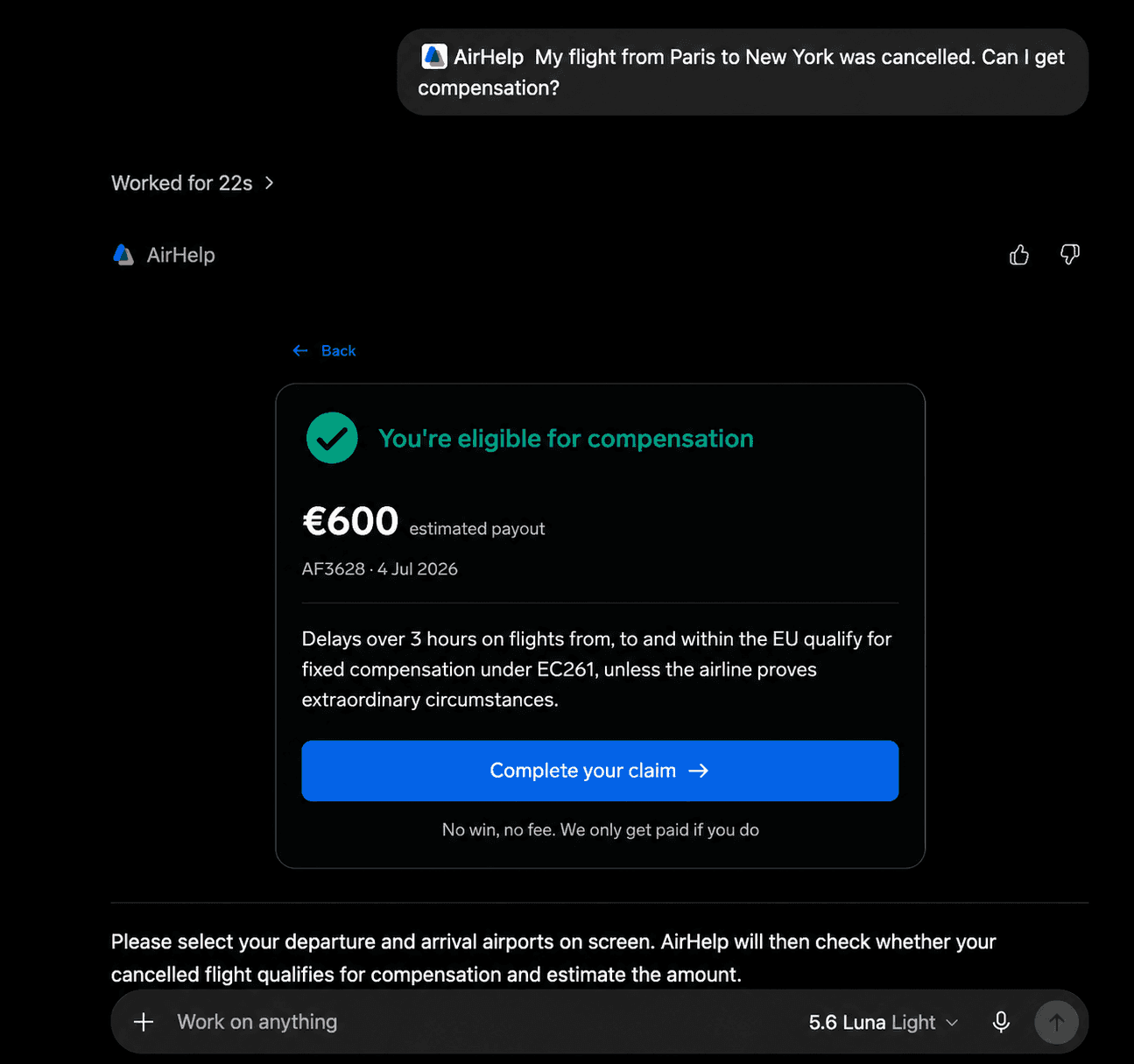
The app runs on three tools under the hood, check_compensation, search_airlines, and search_airports, backing an interactive flight-picker and results view rather than a plain text reply. It's scoped deliberately: it checks flight delay and cancellation compensation only, and doesn't cover flight refunds, baggage claims, travel insurance, real-time flight status, or general trip planning, so the model isn't tempted to answer questions the app can't actually resolve.
Alpic's role
AirHelp came to Alpic with the compensation logic and the regulatory expertise; Alpic brought the MCP-native app design and the infrastructure to build, ship, and monitor their new interface across AI platforms.
App design
Alpic worked with AirHelp to translate its eligibility rules into a small, agent-friendly toolset and an interactive widget flow instead of a single do-everything endpoint. That included handling edge cases that only show up when users start typing: unresolved airline abbreviations, overnight and multi-leg connections, distinguishing a direct flight from a connecting one when both exist on the same route and date, and giving the model enough structure to ask a clarifying question instead of guessing at an itinerary.
One app, two platforms
Built on Alpic's Skybridge framework, the app ships from a single codebase and is available in both the ChatGPT Plugin Store and Claude Connectors Directory, with the same tools, the same widgets, and the same eligibility logic on both sides.
Full-service cloud infrastructure
In addition to helping Airhelp build the app, Alpic handled deployment, testing, and store submission for both platforms, including:
A live playground for testing new versions against a real LLM before shipping to production.
Beacon audits that check tool quality, compliance, and completeness against ChatGPT and Claude store requirements.
Submission packages prepared for both directories, plus a swap from staging to AirHelp's production API ahead of launch.
Analytics
Through the Alpic cloud platform, AirHelp gets visibility into usage from day one, by platform, by tool, and by outcome (eligible, not eligible, flight not found).
AirHelp went from a working prototype to a submitted, production app on both stores in a matter of weeks, not months.
Ready to build your AI app?
Your customers are already asking ChatGPT and Claude questions your product could answer. Alpic helps companies meet them there, building and deploying the app, supporting store compliance and submission, and keeping it running across every AI assistant that matters.
"People already ask ChatGPT and Claude about everything else on their trip. It made no sense to hope for them to leave that conversation and dig through search results and forms to find out if they're owed compensation. Now we can just answer them, right where they already are."
Monika Laskowska-Kac, VP of Product Growth, AirHelp
Liked what you read here?
Get our newsletter!