/
Basics
Poppy: what the Personal Agent Protocol is and how to ship it

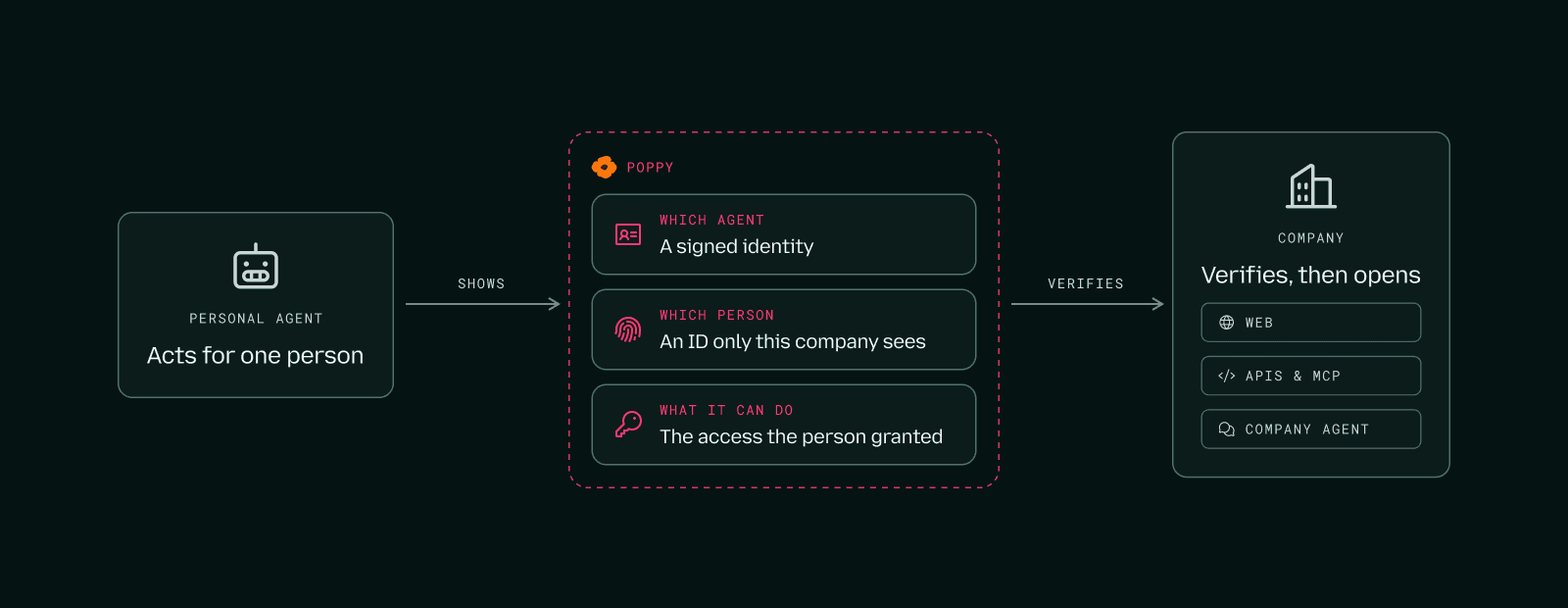
Poppy, short for Personal Agent Protocol, is a draft open standard that lets a company identify the AI agents visiting it: which agent is calling, which person it acts for, and what that person has allowed it to do. With that settled, the agent can browse the company's site, call its APIs or talk to its support agent on the person's behalf, as itself rather than posing as the customer.
The protocol is designed to solve an increasing conundrum for companies who have no reliable way to tell that they are dealing with an agent, let alone whose. With Poppy, companies can now choose not to refuse agents, but to verify them.
Who’s behind Poppy?
Sierra and Meta introduced Poppy on October 6, 2026 and published draft 0.1 three days later; draft 0.2 is the current version. Eight launch partners back it (Meta, Genesys, Instinct, NiCE, Rocket, Shopify, Stripe and Walmart), and 35 design partners have joined them, from OpenAI and Visa to Okta, Cloudflare and PayPal. The spec is published under Apache 2.0.
How an agent identifies itself
Each agent has a public identity: an HTTPS URL that serves its name, logo and signing keys. A company looks it up to confirm who is calling, then checks every signature against those keys. Each session token is signed with a private key that never leaves the agent, so a token leaked through a log or a malicious web page can't be used to act as the customer.
The person behind the agent is identified separately. The agent gives each person an opaque ID that is different for every company and never derived from personal information, and every session "starts signed out." A company can recognize a returning visitor and keep context before any login, while the ID can't follow that person from one company to the next.
Account access comes only when the person signs in, through an OAuth redirect, a code approved on another device, or credentials they hand their agent.
What an identified agent can use
A company declares what agents may use in a JSON file at /.well-known/poppy.json, listing at least one of three surfaces:
Web, where the agent browses the company's site. With a browser session endpoint, the company can tie that browsing to the agent's Poppy session.
APIs, where the file points agents to an OpenAPI description or a remote MCP server, each labelled so the agent knows which one fits its task.
Agent, a conversation endpoint where the person's agent talks to the company's own agent, with a human able to step in on either side.
Conversations work by posting messages and polling for replies, so nothing has to hold a connection open. The optional Operations extension adds approval for consequential actions: the company proposes exact terms and the person approves them before anything happens.
What's still open
A few choices are still debated. Poppy uses its own conversation format, while PACT, a rival standard, builds on A2A. Poppy also already has extensions while its core is still a draft, and it lets agents sign in with a customer's password, an option some companies refuse to offer.
How to ship it
The smallest valid file declares only the web surface. This allows agents to browse your site as signed-out visitors, which is where most businesses will start. Recognizing agents and their users takes the next step: an OAuth server that verifies agent identities and issues session tokens, and your APIs or MCP server listed under apis. If your MCP server already implements the OAuth flow the MCP spec requires, much of that work is done.
The project's implementation kit covers the rest. Its coding skill surveys your systems, writes a design for you to approve and builds it milestone by milestone, and its validator plays the part of a personal agent against your deployment.
Control on both sides
Poppy's larger shift is who sets the terms. Today an agent decides on its own how to approach a business, usually by logging in as the customer. Under Poppy, the business declares how agents may work with it, and the customer decides how much access their agent gets. While the standard is still in its infancy, with the backing it already has, we expect more and more businesses to adopt it.
Liked what you read here?
Get our newsletter!