/
Use cases
Travel’s new front door: how AI is reshaping the way we plan trips
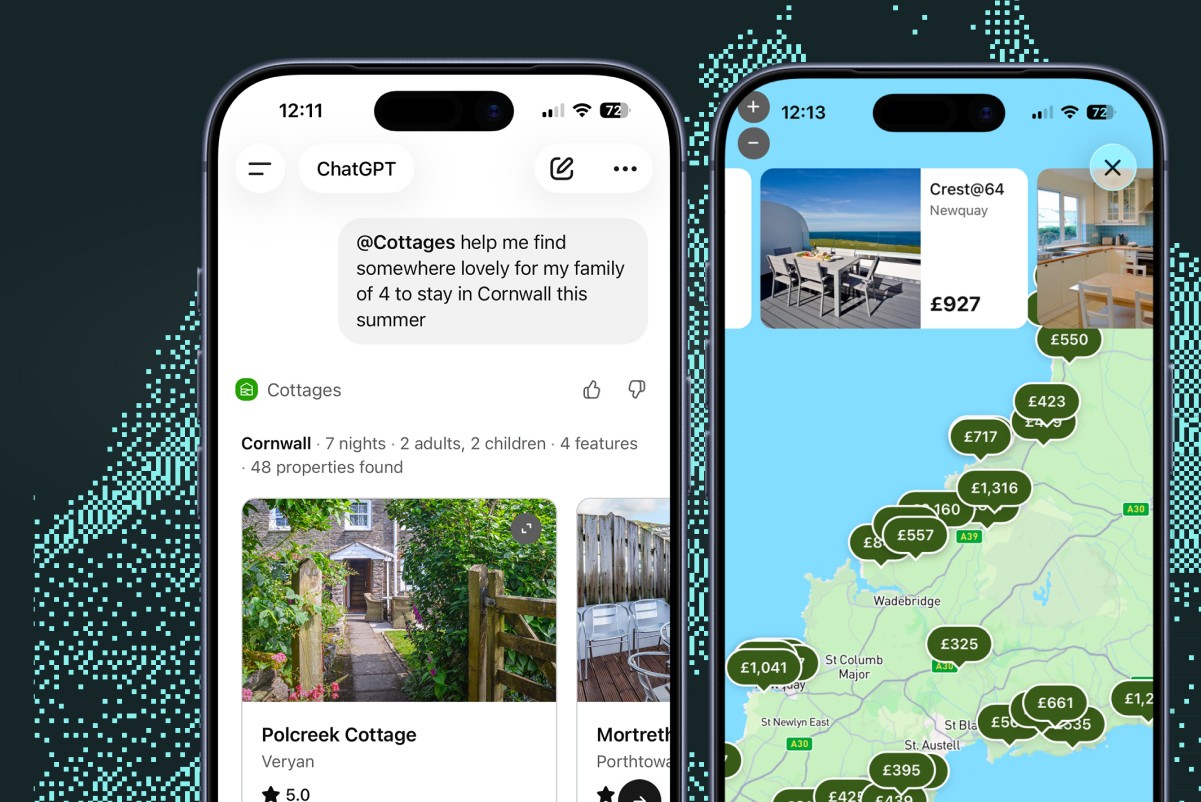
Travel has always been one of the most complex purchases people make online. A single trip can involve hours of research across dozens of tabs: comparing flights, scanning hotel reviews, checking train schedules, finding activities. The whole process is long, fragmented, and exhausting. And the stakes feel real: it's often a significant investment, one where a wrong date or a cancelled reservation doesn't just cost money, it ruins a holiday you've been planning for months. That's exactly why travel is one of the first industries being reshaped by AI.
According to Phocuswright, around 40% of travelers globally have already used AI-based tools for planning. 48% of millennials and 42% of Gen Z say they are more comfortable using AI for trip planning compared to a year ago.
When ChatGPT launched its app ecosystem, travel was the first vertical to move. With over 900 million weekly users, ChatGPT is rapidly becoming a new distribution channel for this industry. One where travelers don't search and browse, but ask and get. For travel companies, the implications are enormous.
1. Why travel is a natural fit for AI agents
Ask any of your friends if they've used AI to plan a trip. The answer is almost always yes. Before any formal booking, people are already using it to get an itinerary, find the best neighborhoods to stay in, or figure out the right time of year to visit. This isn't a niche behavior, it's becoming the default starting point for how people think about travel. Here's why the fit is so natural.
Natural language replaces clunky search interfaces
Anyone who's tried to book a flight on a traditional OTA knows the experience: dozens of filters, dropdown menus, date grids, and price alerts. Booking.com at one point surfaced over 300 filter options for hotels. ChatGPT collapses all of that into a single sentence. The model understands context, handles ambiguity, and doesn't require you to know the right filters to get good results.
Memory and personalization change the quality of recommendations
A model that knows you travel with two kids, prefer aisle seats, and always stay in calm areas can surface options that a generic search engine never would. As AI assistants begin to develop persistent memory, the gap between a tailored travel agent and an AI-powered search interface narrows dramatically. The 300-filter problem doesn't just get solved, it becomes nearly irrelevant.
Comparison and decision-making become conversational
Today, comparing three flight options typically means three browser tabs, a spreadsheet, and fifteen minutes. With a well-integrated AI agent, you can ask "which of these has the best layover time and the most legroom for the price?" and get an answer in seconds. The model doesn't just retrieve, it reasons. That's fundamental where comparison is central to every purchase decision.
2. What's live today: a landscape in motion
That structural fit is already showing up in the market. With 50 apps already live, travel accounts for over 20% of the B2C ChatGPT App ecosystem, by far the largest B2C vertical on the platform. The pace of adoption is striking. Here's a snapshot of what's already in the store as of early 2026.
OTAs and aggregators moved first
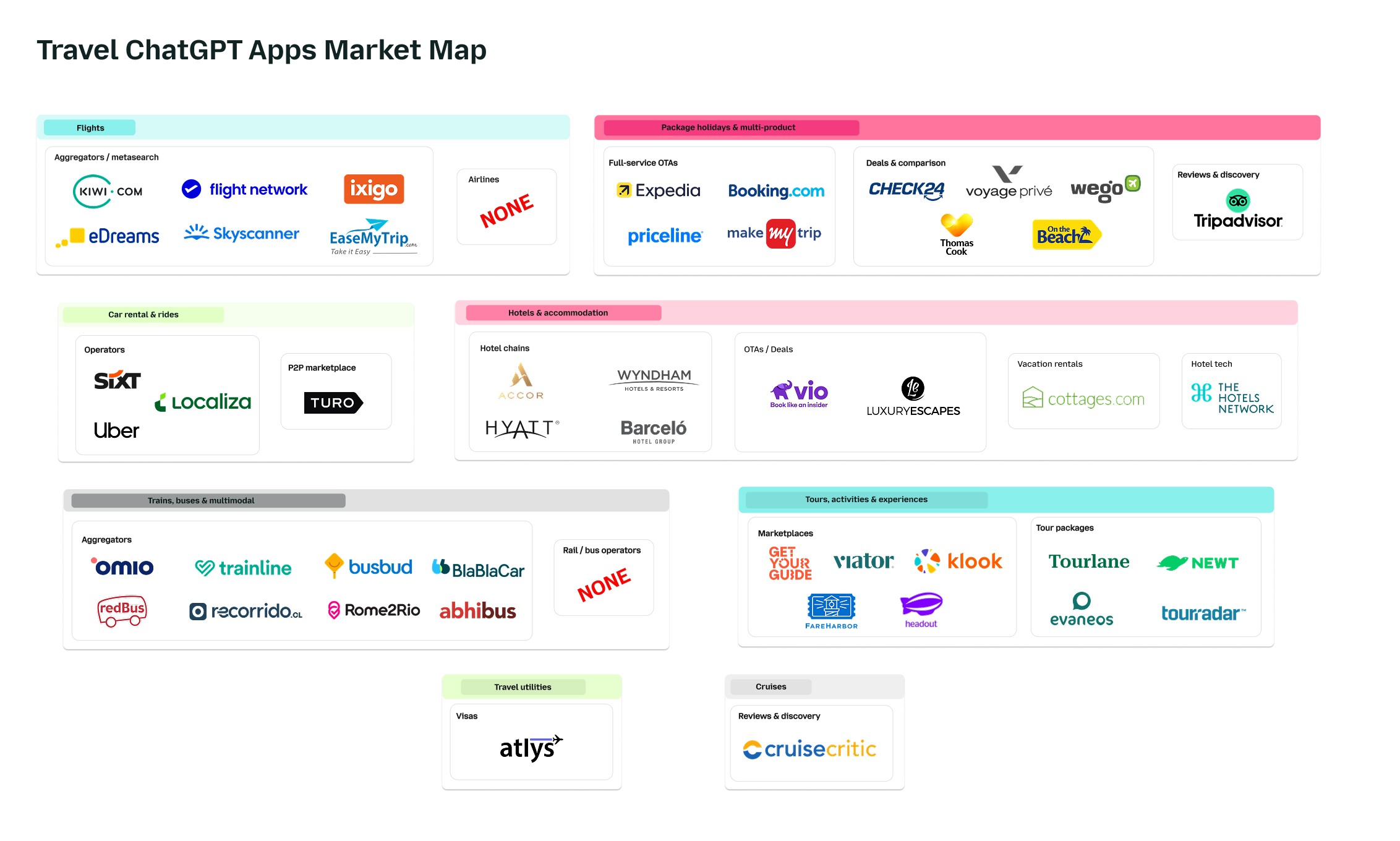
Expedia and Booking.com were the first to go live in October 2025, offering personalized hotel recommendations, flight search with dynamic pricing, & interactive maps. Dozens followed in early 2026: Kiwi.com, Skyscanner, Priceline, CHECK24, eDreams, Omio, Wego, Vio.com, Flight Network, MakeMyTrip, Voyage Privé, Cottages.com and others are all live, covering flights, hotels, buses, trains, and package holidays. Rome2Rio also launched, helping travelers compare any combination of transport modes door-to-door in a single query.
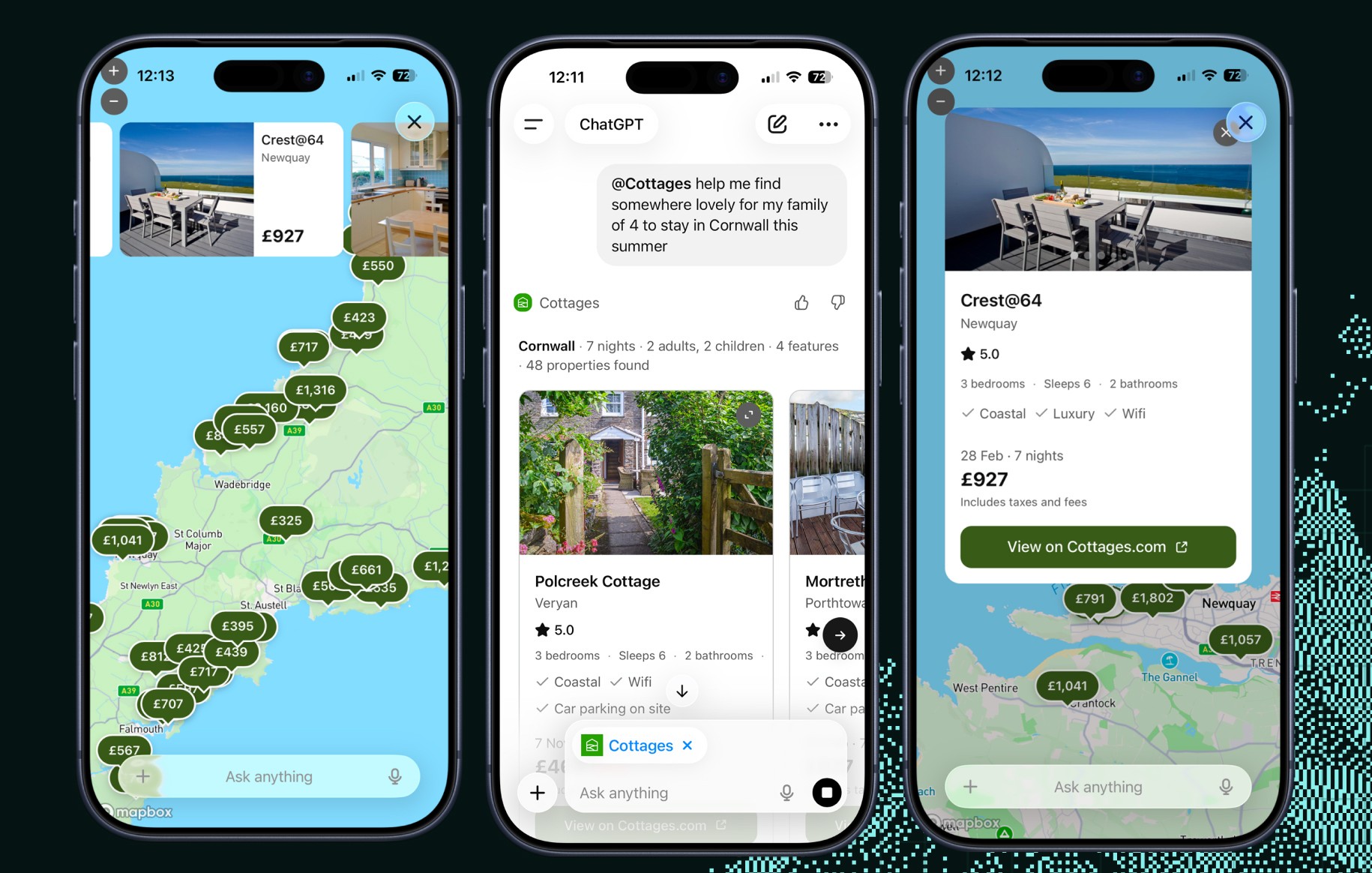
Example of a ChatGPT App: Cottages.com
Direct suppliers followed
Accor launched its ChatGPT app in early 2026, giving users access to its global hotel portfolio. Hyatt, Barceló, and Wyndham Hotels & Resorts followed suit. Turo is live for peer-to-peer car rentals, alongside SIXT for traditional car hire. TheHotelsNetwork rounds out the segment with direct hotel rates from independent properties.
Tour operators are emerging as one of the strongest segments
Activities and experiences is also a well-covered category in the ecosystem. GetYourGuide, Klook, Viator, FareHarbor, TourRadar, Tourlane, Evaneos, Headout, and Cruise Critic are all live. This isn't accidental, tours and experiences are high-margin, inventory-rich, and inherently conversational to discover. "What should I do in Kyoto for two days?" is a natural AI query, and these operators are positioned to answer properly.
Rail and shared mobility: catching up fast
Trainline has launched, bringing multimodal train and coach search across the UK and Europe into the ecosystem. BlaBlaCar is now live, covering carpooling, bus, and train in a single app. Omio and Busbud cover long-distance bus and rail across dozens of markets. The gap is closing, but direct rail operators (Amtrak, Eurail, Deutsche Bahn, or SNCF) remain absent.
Airlines: the most notable gap
Not a single airline has released a ChatGPT App. Every flight result comes from an OTA. The airline's own pricing, seat inventory, and loyalty program are completely invisible. For an industry that's spent years fighting dependency on third party distribution, this is both a notable gap and a huge opportunity.
A full view of all apps currently live can be found in the market map below, which is available for download at the end of this article.
3. The distribution shift: from "search and browse" to "ask and get"
What this adds up to is more than a new channel. It's a structural shift in how travel gets discovered, compared, and sold.
For two decades, travel distribution followed the same model: search, scan, click, compare across tabs, book. ChatGPT Apps are compressing that flow. The traveler describes what they want in plain language; the AI returns options with prices, photos, and booking links, and in some cases, completes the action directly. The journey from intent to booking gets shorter, but not necessarily less complex. Let’s dive into the nuances of this new distribution.
The distribution moat is changing
In the search era, visibility meant ranking on Google. The moat was SEO, SEM spend, and brand recognition. In the AI era, visibility means being the service the AI refers to and can actively use. The moat therefore shifts to two things: the quality and structure of your data, which determines whether AI recommends you, and the quality of your app experience, which determines whether AI can transact with you. Companies that only optimize for the first will get mentioned. Those that invest in both will get booked.
Discoverability is still a moving target
GEO (generative engine optimization) is an emerging discipline, but the black box of AI recommendation isn't fully understood yet. True proactive discovery, where the AI spontaneously surfaces a service without being prompted, isn't reliably here. Today's integrations are mostly reactive: the traveler names a brand, the AI retrieves. However, the companies building solid integrations now will be best positioned when spontaneous recommendation matures.
Conversion dynamics are shifting
Fewer steps means higher completion rates. When a traveler can go from intent to live options in under two seconds, the traditional funnel compresses. Early data confirms it: according to Expedia's VP of Strategic Partnerships, traffic from ChatGPT converts to bookings at higher rates than traditional channels.
Transactions are heading to the chat
One question cuts across everything in this landscape: once a traveler finds what they're looking for, where does the actual purchase happen?
OpenAI's answer has evolved to place checkout directly in the company’s app itself. The transaction stays within the ChatGPT ecosystem but is shifted to the vendor’s workflow.
For travel companies, this has a concrete implication. A booking link redirecting users to your site is a workable interim solution (which most already use), but it's not where this is heading. The expectation, as the platform matures, is that the full journey - search, compare, book - happens without the user ever leaving the chat window.
Which brings the question back to who's actually ready for that world.
4. OTAs vs. direct suppliers
OTAs have a head start, as they moved first. Their inventory is aggregated, their integrations are live, and their link attribution rate in ChatGPT is roughly five times higher than airlines'. In the current phase, they are winning the AI distribution game.
The irony is that direct suppliers such as airlines have everything they need to compete. GDS systems, NDC APIs, real-time seat inventory, dynamic pricing at scale, loyalty data… the infrastructure is there; what's missing is urgency. Not a single major carrier has a ChatGPT App. For an industry that has spent years fighting OTA dependency and pushing direct booking, that's a significant gap.
The path to reclaiming that relationship is straightforward: build the integration, expose your own inventory, and own the customer from the first query. Airlines that do this get to surface their own pricing, loyalty benefits, and ancillaries directly, without an intermediary taking the attribution. Those that don't will keep ceding ground they spent years trying to recover.
What's next
The race is on. In under six months, travel became the largest vertical on ChatGPT's app ecosystem with OTAs moving first, direct hotel brands following, and tour operators close behind. Airlines remain the most glaring gap.
The window to act is now, when the channel is taking shape.
And while OpenAI was the first to act, this isn’t just about ChatGPT. Claude’s connector directory is gaining ground in both the B2B and B2C space. More importantly, Google is watching this channel closely, and it holds cards that the AI labs don’t: search intent data at scale, map infrastructure that ties seamlessly into travel planning, and hundreds of millions of users who already start their trips in Google Search. If Google decides to build its own app ecosystem, the battle for AI distribution in travel won't be a skirmish. It will be a land grab, and the companies with live integrations, clean data, and agent-ready infrastructure will be the ones with something to defend.
The cost of waiting isn't staying neutral. It's ceding ground in a channel you haven't entered yet.
Liked what you read here?
Get our newsletter!