/
MCP Guides
Mapping the 2026 MCP ecosystem: the year AI-first interfaces scale
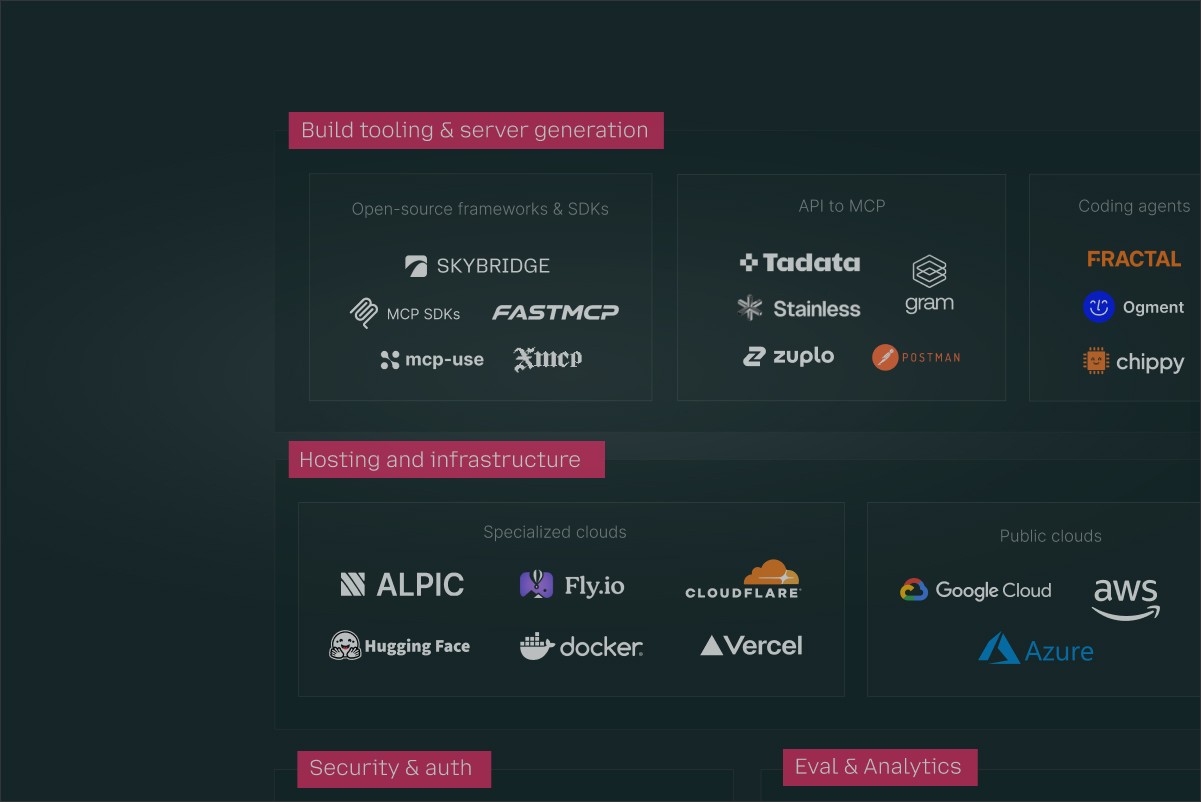
If you look back just twelve months, MCP was an Anthropic experiment for developers that didn't even support remote servers. Today it's an international Linux Foundation standard supported by all major AI players: OpenAI, Anthropic, Microsoft, Google, Mistral and more. That's wild when you think about it.
As we get into 2026, it's increasingly clear that AI is becoming the internet's new front door, replacing traditional websites, apps and dashboards. OpenAI approaches a billion weekly active users, and half of Google searches now surface AI summaries before ever directing the user to a website.
MCP has emerged as the glue allowing AI systems to interact reliably with the digital world. As agents move from answering questions to performing actions on our behalf, this layer is becoming mission critical.
The ecosystem today
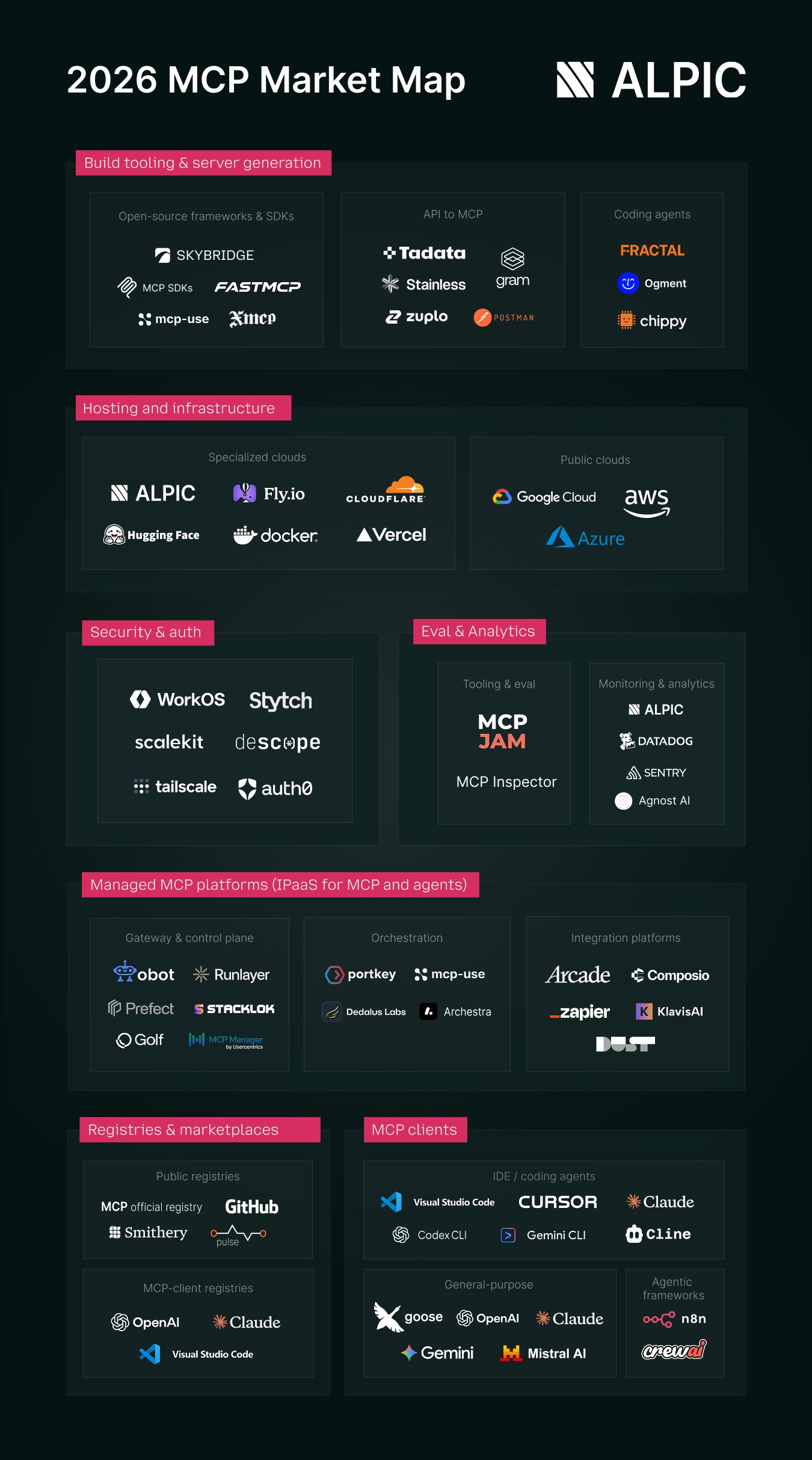
This market map is our humble attempt to capture a snapshot of the moment. The list is not meant to be exhaustive, as new companies appear daily and established players pivot.
Plus, new patterns are emerging constantly: skills, agent.md, and approaches that haven’t even been named. What looks foundational today might be a footnote tomorrow (remember RAG?). However, we firmly believe that AI will always need a strong, standardized way to integrate with the digital world, and today that’s MCP.
This map therefore highlights the companies currently contributing the most meaningfully to the ecosystem. This includes companies that:
are VC-funded startups or established companies as of the time of writing
have MCP at the core of their business or demonstrate clear commitment to MCP products, not just surface-level support and a press release
The map spans the full stack of what it takes to build, deploy, and use MCP in production:
Tools for building: Open-source frameworks, API-to-MCP converters, and coding agents that make it easier to create MCP servers and AI apps (ChatGPT Apps, MCP Apps, etc.).
The infrastructure layer: Hosting, security and authentication, evaluation and analytics tools that make it possible for MCP to become a production interface.
The managed platforms layer: Orchestration, integration, and control planes, allowing for enterprise-grade MCP deployments for internal agents.
MCP registry/store and MCP clients: The distribution and consumption layer where end users ultimately interact with these systems.
From capability to adoption
One key dynamic shaping the ecosystem is how usage is beginning to scale alongside rapidly expanding capability, especially on the consumer side. Billions of people already use AI to retrieve information; using AI to complete tasks is the next phase of adoption.
In enterprise settings, AI workflows are becoming increasingly embedded across organizations. MCP is the standard to build agents that access internal systems, and companies are experimenting and looking to harden these systems.
On the consumer front, the ecosystem is earlier but forming quickly. ChatGPT opened their App Store to developers in December 2025 with just a few dozen apps. For comparison, the first iPhone App Store launched with roughly 500 apps back in 2008, well before mobile platforms became the default way billions of people interacted with software.
But unlike 2008, model progress moves orders of magnitude faster than we've ever seen. Improvements compound quickly, and adoption tends to follow. The gap between capability and real-world usage is shrinking.
What 2026 requires
Success will not rely on models alone, but on the quality of the apps and agents built on top of them. If 2025 was the year of experimental MCPs, 2026 needs to be the year services fully commit to building MCP products alongside their APIs, dashboards, and mobile apps. This means a real production strategy: dedicated infrastructure, authentication, evaluation, and analytics, treating this new interface as a first-class citizen rather than a proof of concept.
This shift will also enable a new category of companies. Some products will be MCP-first, or even MCP-only, designed primarily for agents rather than humans. These companies will build robust and complex applications, capable of executing real workflows end to end. And they'll need vendors and infrastructure partners whose products are built for AI-first workflows.
The companies, products, and open-source projects highlighted in this market map will play a key role in making that happen.
And Alpic is not the least of them! We're committed to helping companies transition to this agent-first internet by making their products and services accessible to AI. We're helping them build the interface with open-source tooling like Skybridge, which improves developer experience and enables cross-platform compatibility. We're helping them deploy and scale with a platform purpose-built for MCP, and understand performance with analytics designed specifically for this new interface. As use cases expand, we look forward to expanding that vision to new parts of the stack, always with the same goal: help businesses make their products and services accessible to AI.
2025 laid the foundation. 2026 is when it scales. And we can't wait to be part of it.
Download the map and see the full full version below!
Liked what you read here?
Get our newsletter!